





Hello Solar Genius,
Do you know Bi-facial solar cells made up 45% of the world market share of solar cells in 2021, now it will reach now up to 60%.
Using bi-facial solar module we can get 30% more generation which is as per installation area and availability of base reflection materials.
While we do installation, it need to care for more generation. In recent time the cost of solar bi-facial panels is reduce and thanks to more efficient.
A bifacial solar module is a module that can collect energy from the front side and the rear side too. This technology is too oldest but no famous or not be commercial due to high price and low efficiency. Due to improvement of technology, efficiency and low price now panels are gaining traction once again in the market.
As per ITRPV (International Technology Roadmap for Photovoltaics), the percentage is expected to increase to 80% by 2023. In fact, the solar tracker manufacturers also stated that the majority of recent solar projects using their tracking system with this module.
Why Bi-facial ?
HIGH SAVING
Lower LCOE, reduced BOS cost, shorter payback time
HIGH EFFICIENCY
Excellent module conversion efficiency of up to 21.70%
LOW-LIGHT PERFORMANCE
Advanced glass and cell surface textured design ensure excellent performance in lowlight environment
PID RESISTANCE
Excellent Anti-PID Performance guarantees limited power degradation for mass production
IP68 JUNCTION BOX
High waterproof level
When & Where we can use Bifacial Solar Module?
Generally, Solar PV panels are made up of one of two different types of crystalline cells monocrystalline or polycrystalline cells. Bifacial PV panels are usually manufactured using p-PERC bifacial cells. The panels tend to be more efficient since each solar cell is made up of a single silicon crystal (monocrystalline cells):
allowing electricity-generating electrons more space to move. Monocrystalline cells are more expensive. Solar cells in bifacial solar panels are exactly the same as in mono-facial solar module. The only real difference lies in how the module is made.
The traditional mono-facial solar panels have an opaque back sheet. On the other hand, bifacial solar panels have a reflective back or dual panes of glass holding the solar cells in place for absorbing the solar energy from both the surfaces. The panels are and are completely transparent, usually frameless without metal gridlines. This makes them stronger in structural integrity and easier on the eye.
HOW DO BIFACIAL SOLAR PANELS WORK?
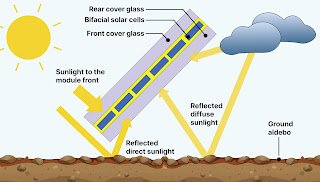
Bifacial solar panels work just like normal solar panels. There is a potion of sunlight that is directly absorbed by the solar cells and converted into electricity. Along with a portion of sunlight that is trapped inside the glass that bounces around until it is absorbed by a solar cell. And finally there is a portion of light which passes right through. However this is where bifacial panels and mono-facial panels are different. In a bifacial panel this loss light then has a chance to be reabsorbed by the panel. In this instance, where the light passes right through and collides with a highly reflective surface, this then bounces back towards the panels, to be converted into solar energy. As a result of exposing both sides of the solar cells to sunlight, bifacial solar panels are capable of generating more solar energy.
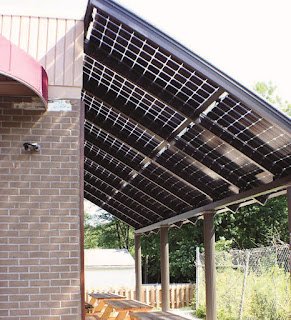
Bifacial solar panels perform best when installed near highly reflective surfaces. Such as swimming pools glass, sandy, Stoney or snowy areas. Although the front of the panel still absorbs the majority of the sunlight, some bifacial models are capable of increasing energy production by up to 30%. The exact amount of extra energy will depend on the environment surrounding the solar panels themselves.
PROS & CONS OF BIFACIAL SOLAR PANELS
Bifacial solar panels are becoming increasingly popular, gaining attention due to both their affordability and efficiency. More homes and businesses are choosing to install bifacial over mono-facial panels to reap the rewards, but do the advantages truly outweigh the disadvantages?
THE ADVANTAGES OF BIFACIAL SOLAR PANELS
Increased Efficiency. As bifacial modules can produce powers from both sides of the panel, there is an overall increase in energy generation. Some manufacturers claim that bifacial solar panels can generate up to 30% more energy than conventional mono facial solar panels. This higher efficiency translates into less space per watt, so homeowners can install fewer panels to meet their needs.
More Durable. As bifacial panels are frameless, and are covered both sides by tempered glass, they’re often more durable. The tempered glass is weather-resistant, UV resistant and can withstand high temperatures and strong winds. As a result of their durability, bifacial solar panels are expected to have longer lifespans.
Aesthetically Pleasing. Bifacial modules come in many designs, including frameless. Many see the complete glass frame more aesthetically pleasing compared to mono facial solar panels.
Works Well in Diffuse Light. The extra surface area also means that bifacial panels perform better in diffuse light. Making the long-term costs lower than monofacial panels.
Reduced PID. In the instance of a frameless bifacial panel, the solar cells are less likely to suffer from potential-induced degradation (PID). This is where electrical currents stray from their intended path and as a result corrodes the solar panels. Furthermore, bifacial panels without a metal frame don’t require grounding, as there are no metal contacts on the exterior.
Longer Warranties. Bifacial solar panels often come with a longer warranty of up to 30 years.
THE DISADVANTAGES OF BIFACIAL SOLAR PANELS
Initial Costs. Due to the manufacturing process, bifacial solar panels can cost up to 10% more than mono-facial solar panels.
Installation Costs. As bifacial solar panels are heavier, and require specialized equipment to take full advantages of the benefits, the installation costs are higher.
Less Flexible. In order to take true advantage..